Showing posts with label Star Trek The Undiscovered Country. Show all posts

30 Oct 2020

The size of the Excelsior Class

The Excelsior-class was a type of Federation starship used by Starfleet from the late 23rd century through the late 24th century. As a long-range research vessel, it was the backbone of Starfleet for nearly a century, making it one of the fleet's longest-serving spaceship designs. The Excelsior-class was later replaced by the Sovereign-class.
  • The premise for all my deck calculations: a deck is 2.5m + 0.5m for EPS cables, power cables, ... = 3m height for a deck. 
  • My calculations follow a purely mathematical approach. I do not compare bridge modules or disk heights with each other. I always pull in decks based on the rows of windows and then calculate a physically plausible room height.
If you consider two decks for the outer part of the saucer (deck 7 + 8), the result is a perfect division of the decks for the whole ship. This gives the height of the neck to the main body an even number of decks.

schematic by TheLightWorks

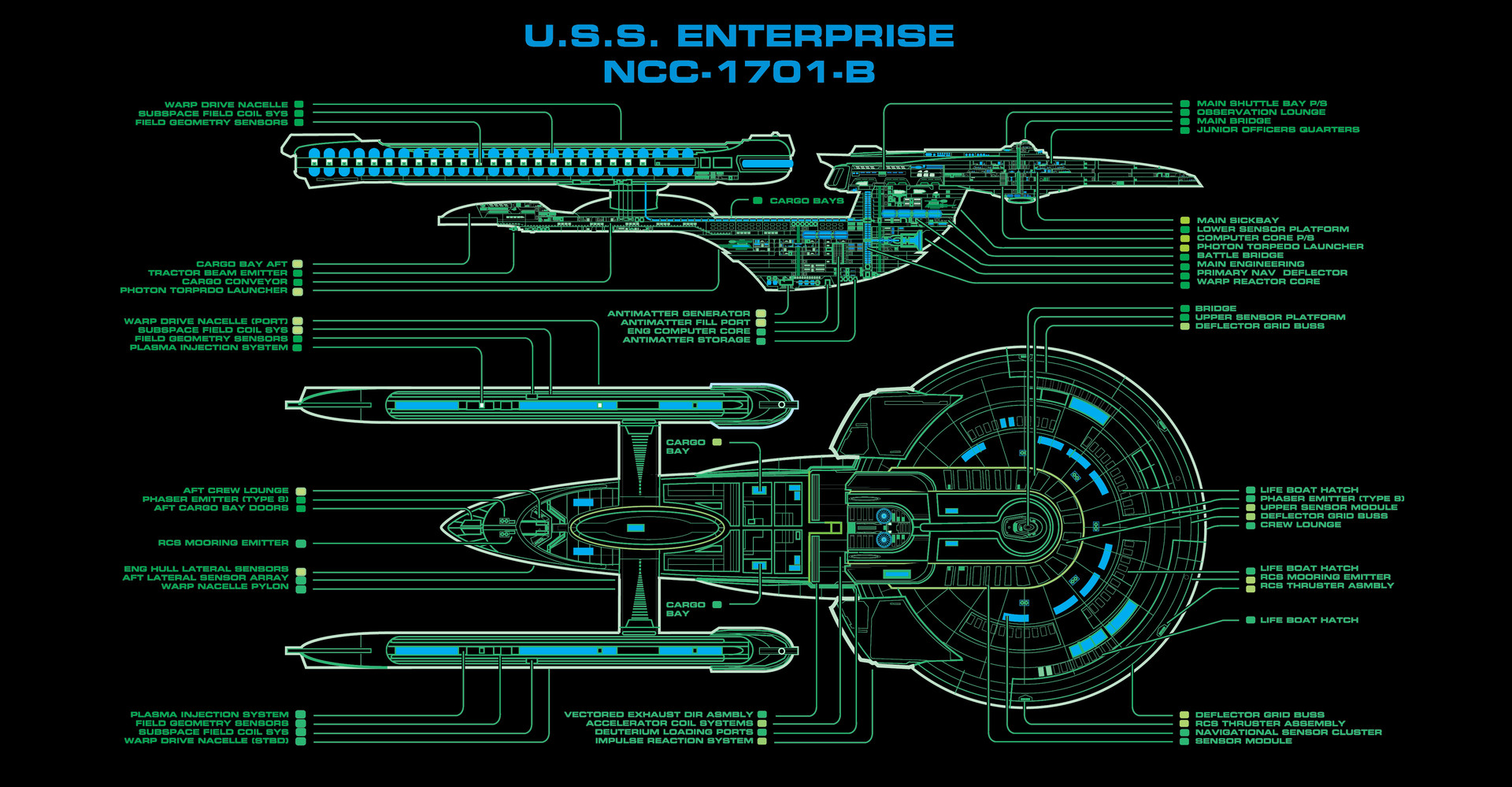
The large MSD (Master Systems Display) from the background of the Excelsior class bridge also gives the number of decks that I calculated: 32.

Doug Drexler with his MSD of the Enterprise-B (artstation.com)

MSD Enterprise-B by Doug Drexler (artstation.com)

Incidentally, this division also corresponds exactly with the additional construction on the main body of the Excelsior Refit (USS Enterprise-B). The place where the Nexus energy ribbon hits the Enterprise-B and thereby pulls Captain Kirk into the Nexus is exactly two decks high.
 
screencapture by trekcore.com (Star Trek: Generations)

According to Andrew Probert's size chart (he extended the ILM chart for Star Trek: The Next Generation, sizing his Ambassador concept halfway between the Excelsior and the Galaxy class), the official length of the ship is 467m (1531 ft). If you pull decks into the side view of the spaceship, this size seems a bit too small. 

ILM Size Chart by Andrew Probert

Commented on this by Bill George of ILM:
"The only description we had at the time was that it was "souped-up" and bigger than the Enterprise. The size the miniature was built to was determined by the camera guys as being the optimal size to shoot. As I recall Nilo [Rodis-Jamero] did that size comparison chart, but it wasn't necessarily followed. The issue of true scale wasn't a consideration. Budget, ease of use, art direction and dramatic intent were what influenced the construction of the ship."
After calculating the decks, this results in a length of 606.9m.

If the Excelsior class were 467m long, then its decks would be only 2.3m high (inclusive 0.5m for EPS cables, power cables, ...). Then only 1.80 m remained for the clear height of the rooms.

The size of 606.9m corresponds much more to what can be seen optically in the Star Trek series:
 
screencap TNG:
"Encounter at Farpoint" 
by trekcore.com
screencap TNG:
"The Child" 
by trekcore.com


screencap DS9: "Paradise Lost" 
by trekcore.com
screencap DS9: "Favor the Bold" 
by trekcore.com


Size calculation:
Excelsior II class (PIC)

21 Dec 2019

Qo'noS One - K'Tinga Class Studio Model - reference photos


Here you can see the reference photos in the final state of the Qo'noS One studio model. Originally shared with Kurt Kuhn in 2008, and shown on Modeler Magic back in January 2009, (Courtesy of Jim Creveling, through Mark Dickson).


Here you get to the COLOR CORRECTED PHOTOS.

23 Nov 2019

Qo'noS One - K'Tinga Class Studio Model - reference photos - first paint


Bill George has posted the photos of the first painting of Qo’noS One with the K’Tinga class photos from Star Trek The Motion Picture. You can still see significant differences: so are not much etching parts mounted on the ship and the dome on the bottom before the impulse drive was later revised. Incidentally, the etched parts in front of the “radiator” come from the Tyrell building seen in Blade Runner.


Here you get to the COLOR CORRECTED PHOTOS.

31 Mar 2015

Star Trek VI - Klingon QO'NOS ONE - Etch Part Review

To build the Qo'nos One correctly you need of course the matching etched parts. I bought them to convert my K'Tinga Class model kit into a Qo'nos One. They are incredibly fine and detailed.


30 Mar 2015

Star Trek VI - Klingon QO'NOS ONE - Kit Review

I bought the resin upgrade kit parts to convert the plastic model kit K'Tinga Class (turquoise parts) into Chancellor Gorkon's flagship Qo'nos One (seen in Star Trek - The Undiscovered Country).

There are a lot of resin parts that are replaced in the existing kit. The details speak for themselves!


Furthermore, there are components that are added in the present kit:


And finally, the special design of the warp nacelles:


For all who are interested in the sizes of the spaceships, HERE is an interesting article. Following the arguments of this article, you get a Qo'nos One in 1/1000 with the conversion parts.

13 Apr 2014

Is a Klingon K'Tinga Class 214m long?

The official size of a Klingon K'Tinga Class is 214m. The length of this ship was determinated for the first Star Trek movie "The Motion Picture" in accordance with the bridge set.


design scetch and bridge layout by Andrew Probert (memory-alpha.org)
 
To calculate the size of the bridge I used the original blueprints and based my calculations on the diameter of the opening for the elevator. This opening measures 2.64m (8'-8").


  • The premise for all my deck calculations: a deck is 2.5m + 0.5m for EPS cables, power cables, ... = 3m height for a deck.
  • My calculations follow a purely mathematical approach. I do not compare bridge modules or disk heights with each other. I always pull in decks based on the rows of windows and then calculate a physically plausible room height.
So we got this result for the decks in this ship:
 
schematic by Strategic Design

design problems:
  1. The bridge blueprint above doesn't match with the size of the structures. The bridge would then be a bit too long and the round area where the elevator is located wouldn't fit into the tower structure. The size of the bridge leaves no room for an outer shell (wall thickness).
  2. A Klingon who is at the top of the tower can't look out the windows because these windows are at the level of the abdominal muscles. 
  3. We have on deck 4 two rows of windows but only one deck.
  4. The second row of windows on deck 4 are in height of the feet. 
  5. The row of windows on deck 7 are also in height of the feet.
  6. The lounge at the end of the "neck part" is cut by decks 5 and 6 because it lies exactly halfway.
  7. The "neck-head contact point" would only be 1.5 decks high. This seems very unstable and like a built-in vulnerable weak point.
 
screenshot by trekcore.com (Star Trek I)

We wouldn't have this problems if we use a length of 349.54m
All windows are always correctly positioned at this size. The lounge at the end of the "neck part" has a plausible position.
 
schematic by Strategic Design
 
In Star Trek VI "The Undiscovered Country" the Qo'noS One looks bigger than 214m. The Enterprise-A is 305m long and flies in the background. The vessels fly at the same angle. As Chekov says in the scene before the Enterprise is very near of Qo'noS One.
 
screenshot by trekcore.com (Star Trek VI) 
 
Even in Deep Space Nine the K'Tinga classes are not shown only 214m. Then they would only be as long as a Vor'cHa class warp nacelle. In "The Way of the Warrior" they fly in the background and are significantly longer than a warp nacelle. And in "Call to Arms" you can also see them in the background and between other Starfleet ships.
 
screenshot by trekcore.com
(DS9: "The Way of the Warrior")
 
screenshot by trekcore.com
(DS9: "Call to Arms")